
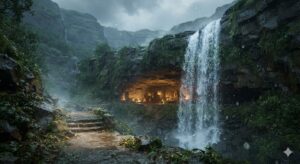
In the misty, green mountains of the Sahyadri ranges near Mahad lies the historic cavern of Shivtharghal. It was here, sheltered from worldly noise, that the 17th-century saint-philosopher Samarth Ramdas Swami dictated his masterwork, the Shrimat Dasbodh, to his disciple Kalyan Swami. Within this dramatic setting, torrential waterfalls crash down from towering cliffs, filling the air with heavy mist and thunderous roar. Yet tucked directly behind this wild downpour rests the calm cave known as Sundermath.
While ordinary eyes see only a wild monsoon landscape, Samarth Ramdas Swami uses the terrain as a profound spiritual metaphor for the inner trials a seeker must face before attaining supreme peace.
Verse 1: The Force of Divine Awakening
गिरीचे मस्तकीं गंगा । तेथुनि चालिली बळें । धबाबां लोटल्या धारा । धबाबां तोये आदळे ॥ १ ॥
Giriche mastakee Ganga | Tethuni chalilee bale |
Dhababaa lotalya dhaara | Dhababaa toye aadale || 1 ||
Water rushes down from the top of the mountain like the sacred Ganga falling from the heavens, crashing with a roaring dhab-dhab sound onto the rocks below.
The mountain crest represents the highest spiritual realm, and the rushing torrent symbolizes the descent of divine grace. When true spiritual knowledge first enters the seeker’s mind, it does not arrive like a gentle trickle; it pours down like a mighty flood, sweeping away lifelong ignorance and false pride with unstoppable power.
Verse 2: The Storm of the Restless Mind
गर्जतो मेघ तो सिंधु । ध्वनीकल्लोळ उठीला । कड्यासी आदळे धारा । वातआवर्त होतसे ॥ २ ॥
Garjato megha to sindhu | Dhwanikallol utheela |
Kadyasee aadale dhaara | Vaataavarta hotase || 2 ||
The waterfall roars so loudly that it echoes like thunderclouds and a stormy sea. As the water hits the mountain cliff, it creates powerful whirlpools of wind.
This storm illustrates the chaos of our everyday thoughts (chitta vritti). Our minds are filled with endless desires, worries, and loud debates that sound like a crashing ocean. When a seeker begins their spiritual journey, all their inner fears and unresolved thoughts clash violently against the cliff of their conscience, creating temporary inner turmoil.
Verse 3: The Fog of Illusion (Maya)
तुशार उठती रेणु । दुसरे रज मातलें । वातमिश्रीत ते रेणु । सीतमिश्रीत धुकटें ॥ ३ ॥
Tushaar uthati renu | Dusare raja maatale |
Vaatamishreeta te renu | Seetamishreeta dhukate || 3 ||
Fine spray rises into the air like tiny dust grains, mixing with the soil picked up by the wind. Carried by cold mountain air, it turns into a thick, chilling fog that hides everything from view.
This mist represents Maya—the great illusion of the material world. Just as fog makes nearby objects invisible, our attachments and doubts cloud our spiritual vision. We forget our true divine self because we are blinded by the cold spray of worldly attachments and petty distractions.
Verse 4: The Deep Forest of Daily Life
दराच तुटला मोठा । झाडखंडें परोपरी । निबीड दाटली छाया । त्यामधें वोघ वाहाती ॥ ४ ॥
Daraacha tutala mothaa | Jhaadakhande paroparee |
Nibeeda daatalee chhaayaa | Tyaamadhe vogha vaahaatee || 4 ||
A deep gorge cuts through the landscape, filled with a dense canopy of trees so thick that sunlight cannot pass through. In these dark shadows, cold mountain streams flow quietly along the forest floor.
The deep valley is Samsara—the vast, tangled forest of worldly existence. People get lost under the dark shadows of materialism and forget the clear sky above. Yet, even in the deepest forest, quiet streams of natural goodness (Sattva) continue to flow, offering silent refreshment to those who seek it.
Verse 5: Confronting Inner Fears
गर्जती श्वापदें पक्षी । नाना स्वरें भयंकरें । गडद होतसे रात्रीं । ध्वनिकल्लोळ उठती ॥ ५ ॥
Garjatee shwaapade pakshee | Naanaa sware bhayankare |
Gadada hotase raatri | Dhwanikallola uthatee || 5 ||
Wild animals and forest birds scream in harsh, terrifying voices. As dark night settles over the canyon, the sounds of nature and rushing water build into a frightening roar.
The dark night represents spiritual ignorance (Ajnana), while the predatory beasts are the inner enemies that dwell inside every human heart: anger, greed, jealousy, and fear (Shadripu). Samarth Ramdas teaches that an earnest seeker cannot run away from these fears; one must face the dark night of the soul with unshakeable faith in God.
Verse 6: The Lotus in the Mud and the Sacred Cave
कर्दमु निवडेना तो । मनासीं सांकडें पडे । विशाळ लोटली धारा । तीखालें रम्य विवरें ॥ ६ ॥
Kardamu nivadenaa to | Manaasi saankade pade |
Vishaal lotalee dhaara | Teekhaale ramya vivare || 6 ||
The path is filled with deep mud, making the journey difficult and filling a hesitant mind with doubt. But right behind that massive sheet of falling water lies a beautiful, dry, and peaceful cave.
The slippery mud (kardamu) represents self-doubt and worldly obstacles. Many people turn back here because they lack patience (Dhairya). But those who endure the muddy climb discover that the roaring waterfall was not a wall to lock them out, but a divine curtain meant to keep out the unworthy. Right behind the chaos lies Ramya Vivare—the inner sanctuary of supreme peace (Atma-Shanti).
Summary of the Landscape of Shivtharghal
Shivtharghal is a secluded Sahyadri sanctuary carved out by sheer cliffs, perpetual mist, and dark forest gorges. A towering cascade thunders over the rockface, creating a natural liquid wall that hides the dry, tranquil cavern of Sundermath completely from the outside world.
The Spiritual Metaphor
The physical approach to the cave reflects the inner path to liberation. The treacherous trek, confusing fog, and howling wilderness represent the mind’s battle with Maya, hesitation, and base instincts (Shadripu). The thundering water acts as a final test of endurance, shielding Sundermath—the unshakeable silence of the soul (Atma-Shanti)—from those who lack resolve.
Key Message: The Spiritual Meaning
Samarth Ramdas Swami delivers the vital message that true peace is never gained by seeking an easy, trouble-free life. Divine peace sits directly on the other side of worldly turmoil. To enter our own inner Sundermath, we must cultivate self-discipline, endure the muddy trials of doubt, and walk directly through the roaring waterfall of fear.
Yet, navigating this treacherous mountain pass alone is nearly impossible for an ordinary seeker. When the fog of illusion blinds our path and the inner beasts roar in the dark, our limited intellect falters. It is here that every seeker must surrender their ego and earnestly seek the grace and blessings of the Sadguru. Just as Kalyan Swami found enlightenment in the company of Samarth Ramdas Swami, it is solely the Sadguru’s benevolent light that guides our feet across the slippery mud, parts the torrential curtain of fear, and leads us safely into the quiet cave of self-realization. Pray for the Sadguru’s divine guidance, for without their shelter, the final step into inner silence remains forever out of reach.
|| Jay Jay Raghuveer Samarth ||
Very nicely explained.
Very good n…thanx lot