1. The Sacred Abhang:
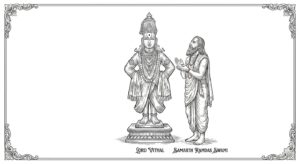
When the great 17th-century saint Samarth Ramdas first visited the holy town of Pandharpur, he stood before the beautiful murti of Lord Vitthal. Deeply anchored in Rama-bhakti (devotion to Lord Rama), his spiritual sight instantly perceived his beloved Shrirama underneath the form of Panduranga. In an ecstatic state of divine yearning and bewilderment, he spontaneously composed this historic 9-verse Abhang (Verse No. 48 in the Samarthanchi Gatha):
Yethe ka re ubha Shrirama | Manamohana meghashyama || 1 ||
(O Lord Rama, why are you standing here? You who captivate the mind, dark-hued like rain clouds!)
Chapa bana kay kele | Kara katavari thevile || 2 ||
(What have you done with your divine bow and arrows? Why have you placed your hands upon your waist?)
Kamba dharila abola | Dise vesha palatala || 3 ||
(Why do you maintain this silent stance? Your attire and form seem completely altered.)
Kay jali Ayodhyapuri | Yethe basavili Pandhari || 4 ||
(What happened to your glorious capital of Ayodhya? Have you built your new Pandharpur right here?)
Sarayu Ganga kay keli | Kaichi Bhima melavili || 5 ||
(Where did you leave the holy Sarayu River? How did you bring the River Bhima to meet you here?)
Kilkilata vanaranche | Thave na disati tayanche || 6 ||
(The joyful chattering of your Vanara army is missing; I see no sign of their vast gatherings.)
Dise Hanumantu ekala | Ha ka sainyatuni futala || 7 ||
(I see Hanuman standing all by himself. Has he broken away from the rest of your divine army?)
Kay jali Sita Sati | Yethe bahuta jana disati || 8 ||
(Where is the virtuous Mother Sita? Instead of her, I see a vast multitude of everyday devotees.)
Ramadasin sadbhava jana | Rama jala Pandharirana || 9 ||
(Know this pure spiritual truth of Ramdas: My Lord Rama himself has transformed into the King of Pandharpur.)
|| Jay Jay Raghuveer Samarth ||
2.Historical Context & The Sacred Yatra
According to traditional bakhars (chronicles) and travel logs referenced in Shri Dasayan, Samarth Ramdas undertook an extensive, multi-year pilgrimage across the Indian subcontinent between Shake 1554 and Shake 1565 (approx. 1632–1643 CE). His rigorous spiritual itinerary included parikramas to major holy centers: Kashi, Prayag, Ayodhya, Badrinarayan, Rameshwaram, Shailya Parvat, Gokarna, Mahabaleshwar, Chiplun-Parashurama, Bhimashankar, and Shikhar Shingnapur, before eventually making his way toward Panchavati via Trimbakeshwar.
Later, in the month of Ashadha in Shake 1571 (1649 CE), he arrived in Pandharpur during the peak of the Ashadhi Wari pilgrimage. Initially, Samarth Ramdas—resolute in his absolute focus on Shrirama—was hesitant to visit shrines of other deities. However, honoring the pure, persistent requests of an elderly Warkari named Vitthal Bhat, he entered the temple. The moment he stood in front of the deity, this beautiful stream of poetry flowed from his heart.
3. Spiritual & Esoteric Symbolism
The Divine Metamorphosis
For an intense sadhaka (spiritual practitioner), the external vestments of the divine are but a veil. Ramdas’s inner eye immediately penetrated the outer form of Vitthal to recognize the inherent Rama-tattva (the essence of Rama). Yet, his poetic enquiry reflects a deep, purposeful bewilderment. He questions why the Kodandadhari (the wielder of the supreme bow) has cast aside his weapons to adopt a quiet, meditative posture with hands resting on his waist (kara-katavari).
Social & Political Metaphor
Behind this mystical dialogue lies a profound sociopolitical undercurrent relevant to the turbulent 17th century. During an era when society was severely oppressed by foreign invasions and adharma, Ramdas found the silent, unarmed posture of the deity striking. Ayodhya represents an imperial, self-defending, and righteously armed spiritual sovereignty. Pandharpur, on the other hand, stands as the spiritual heartland of community, inner surrender, and peace.
Through these verses, Ramdas subtly reminds the collective consciousness of the need for an active, protective, and righteously vigilant leadership (Yuyutsu Netrutva) to safeguard the path of devotion. He wonders why the vast, roaring Vanara-sena (the cosmic army that fought injustice) is absent, leaving a solitary Maruti standing at the gates.
The Synthesis of Hari & Hara
The form of Lord Vitthal is inherently unique—it perfectly synthesizes Hari (Vishnu) and Hara (Shiva). It features a Shiva-linga upon his crown, Makara-kundalas (fish-shaped earrings) reflecting Vaishnava iconography, and the sacred mark of Sage Bhrigu on his chest.
Ramdas honors this all-encompassing supreme consciousness. He teaches that a true Ramadasi does not judge by superficial differences (varvar) but performs an antaranga-pariksha—an inner, deep examination of the divine core. Ultimately, the Abhang establishes that the multi-formed Divine is essentially One, responding seamlessly to the specific bhav (devotional emotion) of the seeker.
Glossary:
- Ashadha (also spelled Ashad or Asadh) is the fourth month of the traditional Hindu lunar calendar and the Indian national (Shaka) calendar. It marks a major seasonal and spiritual transition in India, roughly aligning with late June to July in the Western Gregorian calendar
- “Shake” (often spelled Shaka, Saka, or Śaka) is the standard abbreviation for the Shaka Era calendar system. The Shaka calendar started in the year 78 CE. To convert a Shaka year to the Gregorian calendar (CE/AD), you add 78 years.
- The Calculation: (1571 (Shaka) + 78 = 1649 (CE/AD)
- The Context: “Shake 1571” is highly relevant in Maratha and Indian history. For example, historical records note that Chhatrapati Shivaji Maharaj met his spiritual guru, Samarth Ramdas, for the first time in Shake 1571 (which corresponds to 1649 AD).
Good one…👍
Supper 🌹
खुप खुप सुंदर अभंग विचार.
🙏🙏
Nice….👌👌